Perbandingan Tekanan Darah Sebelum dan Sewaktu Melakukan Handgrip Isometric Exercise pada Mahasiswa Angkatan 2011 Fakultas Kedokteran Universitas Andalas
DOI:
https://doi.org/10.25077/jka.v5i2.537Abstract
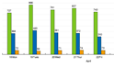
AbstrakHipertensi dapat menyebabkan gangguan jantung yang serius sampai kematian. Handgrip isometric exercise adalah latihan yang melibatkan kontraksi otot lengan bawah dan tangan dengan melakukan cengkraman menggunakan handgrip dynamometer. Tujuan penelitian ini adalah mengetahui perubahan tekanan darah sewaktu melakukan handgrip isometric exercise. Penelitian ini merupakan penelitian eksperimental dengan menggunakan desain randomized crossover study yang melibatkan 24 orang subjek laki-laki dengan usia 20,7 ± 0,6 tahun dan BMI 21,8 ± 2,1 Kg/m2. Hasil penelitian menunjukkan peningkatan tekanan darah baik sistolik maupun diastolik yang signifikan sewaktu melakukan handgrip isometric exercise. Tekanan darah sistolik dari 115,2 ± 5,0 mmHg menjadi 135,0± 6,5 mmHg (p<0,05) dan diastolik 76,3± 5,0 mmHg menjadi 98,3 ± 8,7 mmHg (p<0,05). Pada kontrol terlihat penurunan tekanan darah sistolik yang signifikan dari 113,8 ± 6,1 mmHg menjadi 111,5 ± 7,1 mmHg (p<0,05) dan diastolik penurunan tidak signifikan dari 75,0 ± 5,9 mmHg menjadi 72,9 ± 6,2 mmHg (p>0,05). Pada penelitian ini disimpulkan bahwa tekanan darah meningkat sewaktu handgrip isometric exercise.
Kata kunci: hipertensi, handgrip isometric exercise, tekanan darah
Â
Abstract
Hypertension can cause a serious heart problem and mortality. Handgrip isometric exercise is an activity involving contraction of forearm and hand muscle of one arm by pressing handgrip dynamometer. The objective of  this study was to investigated blood pressure during handgrip isometric exercise. This research was an experimental study with randomized crossover design that involved 24 male subjects, age of 20,7 ± 0,6 years old and BMI 21,8 ± 2,1 Kg/m2. The results demonstrated significant increases in systolic and diastolic blood pressure during handgrip isometric exercise. Systolic blood pressure significantly increased from 115,2 ± 5,0 mmHg to 135,0 ± 6,5 mmHg (p<0,05) and diastolic from 76,3 ± 5,0 mmHg to 98,3 ± 8,7 mmHg (p<0,05). In control group, systolic blood pressure significantly decreases from 113,8 ± 6,1 mmHg to 111,5 ± 7,1 mmHg (p<0,05) and unsignificant decreased in diastolic blood pressure from 75,0 ± 5,9 mmHg to 72,9 ± 6,2 mmHg (p>0,05). It can be concluded that blood pressure increased during handgrip isometric exercise.
Keywords: hypertension, handgrip isometric exercise, blood pressure
Downloads
Published
How to Cite
Issue
Section
License
Authors retain copyright and grant the Jurnal Kesehatan Andalas right of first publication with the work simultaneously licensed under a Creative Commons Attribution-ShareAlike (CC BY-SA 4.0) license that allows others to share (copy and redistribute the material in any medium or format) and adapt (remix, transform, and build upon the material) the work for any purpose, even commercially with an acknowledgement of the work's authorship and initial publication in Jurnal Kesehatan Andalas.
Authors are able to enter into separate, additional contractual arrangements for the non-exclusive distribution of the journal's published version of the work (e.g., post it to an institutional repository or publish it in a book), with an acknowledgement of its initial publication in Jurnal Kesehatan Andalas.
Authors are permitted and encouraged to post their work online (e.g., in institutional repositories or on their website) prior to and during the submission process, as it can lead to productive exchanges, as well as earlier and greater citation of published work (See The Effect of Open Access).