Perbandingan Efektivitas Berbagai Media Ovitrap terhadap Jumlah Telur Aedes Spp yang Terperangkap di Kelurahan Jati Kota Padang
DOI:
https://doi.org/10.25077/jka.v5i2.527Abstract
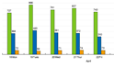
AbstrakAedes spp adalah vektor pembawa virus dengue yang dapat menimbulkan penyakit Demam Berdarah Dengue (DBD). DBD merupakan penyakit menular yang cenderung mengalami peningkatan dan penyebarannya semakin luas. Cara mengurangi penyebaran penyakit DBD dengan mengendalikan vektor, salah satunya dengan memutus siklus hidup vektor dengan  menggunakan perangkap telur/pemasangan ovitrap. Tujuan penelitian ini adalah untuk membandingkan efektivitas berbagai media ovitrap terhadap jumlah telur Aedes spp yang terperangkap. Jenis penelitian ini adalah eksperimental quasi dengan rancangan post test only design. Populasi dalam penelitian ini adalah semua telur Aedes spp yang terperangkap pada ovitrap, sampel diambil dari sepuluh rumah dengan ulangan enam kali. Lokasi penelitian adalah RW I, III, V, VII, IX Kelurahan Jati. Variabel bebas adalah berbagai media (air sumur, air jerami, air kolam, air mineral) ovitrap. Variabel terikat adalah jumlah telur Aedes spp yang terperangkap. Uji normalitas data menggunakan uji kolmogorov smirnov, data terdistribusi normal (p>0,05) dan uji varian data tidak homogen (p<0,05), maka dgunakan uji Kruskal Walls dan Mann Withney. Hasil penelitian diperoleh telur nyamuk Aedes spp yang terperangkap selama penelitian adalah 3.090 butir dengan sebaran 1.563 butir di luar rumah dan 1.527 butir di dalam rumah. Berdasarkan media ovitrap, telur yg terperangkap pada media air jerami 1.758 butir, air mineral 576 butir, air kolam 523 butir, air sumur 233 butir. Uji statistik mendapatkan p = 0,000. Hal ini menunjukkan bahwa terdapat perbedaan jumlah telur Aedes spp yang terdapat pada masing-masing media ovitrap. Disimpulkan bahwa air jerami lebih efektif sebagai media ovitrap daripada air mineral air kolam, air sumur.  Â
Kata kunci: telur Aedes spp, ovitrap, media ovitrap
Â
Abstract
Aedes spp are vectors of dengue viruses that can cause Dengue Hemorrhagic Fever (DHF). Dengue is one of the infectious diseases that the number of sufferers tend to increase and has wider dissemination.The solution to decrease the spread of dengue is by control the vector by using Ovitrap.The objective of this study was to compare the effectiveness of various media ovitrap on the number of Aedes spp eggs trapped.This research was a quasi experimental with post test only design. Population were all Aedes spp eggs trapped in ovitrap , samples were taken from 10 homes with 6 times repeatation. Location of the study were RW I,III,V,VII,IX in Jati .The independent variable is the type of media (wells water, straw water , pool water , mineral water) ovitrap .The dependent variable is the number of Aedes spp eggs trapped. The result of Kolmogorov Smirnov test were normally distributed (p >0.05) , a variant of the test data is not homogeneous (p< 0.05), so analyzed using the Mann Whitney and Kruskal Walls.The Aedes spp mosquitoes that trapped during the study were 3,090 eggs. The distribution of 1,563 eggs outside the home and 1,527 eggs in the house. According to media ovitra; straw water had 1758 eggs, mineral water had 576 eggs, pools water had 523 eggs, well water had 233 eggs (p = 0.000). There is a diference from the four ovitrap media on the eggs Aedes spp.The conclution is the straw water media is more effective than water of mineral, pools and well.
Keywords: eggs of Aedes spp , ovitrap , ovitrap media
Downloads
Published
How to Cite
Issue
Section
License
Authors retain copyright and grant the Jurnal Kesehatan Andalas right of first publication with the work simultaneously licensed under a Creative Commons Attribution-ShareAlike (CC BY-SA 4.0) license that allows others to share (copy and redistribute the material in any medium or format) and adapt (remix, transform, and build upon the material) the work for any purpose, even commercially with an acknowledgement of the work's authorship and initial publication in Jurnal Kesehatan Andalas.
Authors are able to enter into separate, additional contractual arrangements for the non-exclusive distribution of the journal's published version of the work (e.g., post it to an institutional repository or publish it in a book), with an acknowledgement of its initial publication in Jurnal Kesehatan Andalas.
Authors are permitted and encouraged to post their work online (e.g., in institutional repositories or on their website) prior to and during the submission process, as it can lead to productive exchanges, as well as earlier and greater citation of published work (See The Effect of Open Access).