Efek Lama Penyimpanan Asi Terhadap Kadar Protein dan Lemak yang Terkandung Didalam ASI
DOI:
https://doi.org/10.25077/jka.v5i1.444Abstract
Abstrak
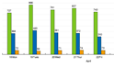
Penyimpanan ASI di lemari pendingin yang dilakukan oleh ibu bekerja kemungkinan bisa menyebabkan terjadinya beberapa proses biokimia seperti proteolisis dan lipolisis. Proses ini bisa menyebabkan terjadinya perubahan dari zat gizi yang terkandung didalam ASI. Tujuan penelitian ini adalah mengetahui efek lama penyimpanan ASI terhadap penurunan kadar protein dan lemak yang terkandung didalam ASI. Ini merupakan true experiment dengan pendekatan pretest-post test control group design. Pemeriksaan kadar protein dan lemak dilakukan di Laboratorium Teknologi Hasil Ternak Fakultas Peternakan Universitas Andalas padang, pada bulan November 2014 dengan total 32 sampel. Sampel dibagi menjadi 4 kelompok, dengan variasi lama penyimpanan di lemari pendingin selama 0 jam (control), 24 jam, 48 jam dan 72 jam. Setelah dilakukan penyimpanan, lalu di uji kadar protein dengan metode Kjedhal dan kadar lemak dengan metode Sochlet. Hasil penelitian didapatkan kadar protein yang disimpan selama 0 jam adalah 0,99%, 24 jam 0,86%, 48 jam 0,78%, 72 jam 0,72%. Terdapat perbedaan yang signifikan rerata kadar protein berdasarkan lama penyimpanan dengan p<0,05. Rerata untuk kadar lemak selama penyimpanan 0 jam adalah 3,4%, 24 jam 3,2%, 48 jam 3,1% dan 72 jam 3,0%. Terdapat perbedaan yang signifikan rerata kadar lemak berdasarkan lama penyimpanan dengan nilai p<0,05. Terdapat efek lama penyimpanan ASI terhadap kadar protein dan lemak yang terkandung didalam ASI.
Kata kunci: kadar protein ASI, kadar lemak ASI, lama penyimpanan
Â
Abstract
Keeping breast milk in cool storage is often done by working mother, may cause biochemical process such as proteolysis and lipolysis. These processes may change nutrition component in breast milk. The objective of this study was to find the effect of duration of storage on breast milk in decreasing protein and fat level contained in breast milk. This study was a true experiment with pretest and posttest control group design. Protein and fat level examined on 32 samples in laboratory of Teknologi Hasil Ternak, Animal Science Faculty of Andalas University Padang in November 2015 . Samples were divided into four groups: 0 hour (control), 24 hours, 48 hours, and 72 hours. After that, protein level was examined by using kjedhal method and fat level was examined by using sochlet method. The result got level of protein in 0 hour storage was 0.99%, 24 hours 0.86%, 48 hours 0.78%, and 72 hours 0.72%. There was significant difference of protein mean level based on storage time, with p< 0.05. The mean level of fat in 0 hour storage was 3.4%, 24 hours 3.2%, 48 hours 3.1%, and 72 hours 3.0%. There was significant difference of fat mean level on duration of storage (p< 0.05). There is effect of time storage to protein and fat level in breast milk.
Keywords: protein breast milk level, fat breast milk level, duration of storage

Downloads
Published
How to Cite
Issue
Section
License
Authors retain copyright and grant the Jurnal Kesehatan Andalas right of first publication with the work simultaneously licensed under a Creative Commons Attribution-ShareAlike (CC BY-SA 4.0) license that allows others to share (copy and redistribute the material in any medium or format) and adapt (remix, transform, and build upon the material) the work for any purpose, even commercially with an acknowledgement of the work's authorship and initial publication in Jurnal Kesehatan Andalas.
Authors are able to enter into separate, additional contractual arrangements for the non-exclusive distribution of the journal's published version of the work (e.g., post it to an institutional repository or publish it in a book), with an acknowledgement of its initial publication in Jurnal Kesehatan Andalas.
Authors are permitted and encouraged to post their work online (e.g., in institutional repositories or on their website) prior to and during the submission process, as it can lead to productive exchanges, as well as earlier and greater citation of published work (See The Effect of Open Access).