Gambaran Tekanan Darah Tikus Wistar Jantan dan Betina Setelah Pemberian Diet Tinggi Garam
DOI:
https://doi.org/10.25077/jka.v2i3.154Abstract
Abstrak
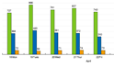
Hipertensi masih menjadi masalah kesehatan di dunia. Penyebabnya diduga berkaitan dengan diet tinggi garam. Tujuan Penelitian ini ialah untuk mengetahui gambaran tekanan darah tikus Wistar setelah pemberian diet tinggigaram. Penelitian ini adalah eksperimental dengan post-test only control group design. Subjek penelitian terdiri dari 10 ekor tikus Wistar jantan dan 10 ekor betina yang dibagi menjadi kelompok kontrol (K) dan kelompok perlakuan (P). Diet tinggi garam (NaCl8%, 3ml/hari) diberikan pada kelompok P selama empat minggu. Hasil penelitian menunjukkan bahwa terjadi peningkatan tekanan darah yang bermakna pada kelompok P bila dibandingkan dengan kelompok K, yaitu tekanan darah sistolik (TDS) 191±17mmHg (P) dan 168±16mmHg (K) (p<0,05), tekanan darah diastolik (TDD) 162±17mmHg (P) dan 139±13mmHg (K) (p<0,05), tekanan arteri rata-rata (TAR) 176±17mmHg (P) dan 156±15mmHg (K) (p<0,05). Peningkatan TDS dan TDD hanya terjadi pada tikus jantan, tidak pada tikus betina. Pada tikus jantan TDS 185±13mmHg (P) dan 159±9mmHg (K) (p<0,05), TDD 159±18mmHg (P) dan 131±10mmHg (K) (p<0,05), TAR 172±16mmHg (P) dan 150±15mmHg (K) (p>0,05). Pada tikus betina TDS 197±19mmHg (P) dan 178±16mmHg (K) (p>0,05), TDD 165±18mmHg (P) dan 148±11mmHg (K) (p>0,05), TAR 181±18mmHg (P) dan 162±14mmHg (K) (p>0,05). Kesimpulan studi ini adalah peningkatan tekanan darah setelah pemberian diet tinggi garam hanya terjadi pada tikus jantan.
Kata kunci: diet tinggi garam, tekanan darah, hipertensi
Abstract
Hypertension remains a health problem in the world. The cause is believed to be related to the high-salt diet. The purpose of this studi was to describe the blood pressure of Wistar rats after administration of high-salt diet. This research was experimental with post-test only control group design. Ten male and ten female Wistar rats were divided into two groups: control group(K) and treated group(P). High-salt diet (8%NaCl, 3ml/day) was given to the P group for four weeks. Blood pressure increased significantly in group P compared to group K, systolic blood pressure (SBP) 191±17mmHg (P) and 168±16mmHg (K) in (p<0.05), diastolic blood pressure (DBP) 162±17mmHg (P) and 139±13mmHg (K) in (p<0.05), mean arterial pressure (MAP) 176±17mmHg (P) and 156±15mmHg (K) in (p<0.05). The increase in SBP and DBP only occurred in male rats, not in female rats. In male rats, SBP were 185±13mmHg (P) and 159±9mmHg (K) in (p<0.05), DBP were 159±18mmHg (P) and 131±10mmHg (K) in (p<0.05), MAP were 172±16mmHg (P) and 150±15mmHg (K) in (p>0.05). In female rats, SBP were197±19mmHg (P) and 178±16mmHg (K) in (p>0.05), DBP were 165±18mmHg (P) and 148±11mmHg (K) in (p>0.05), MAP were 181±18mmHg (P) and 162±14mmHg (K) in (p>0.05). The conclusion of this study is an increase of blood pressure after the administration of high-salt diet only occured in male rats.
Keywords: high-salt diet, blood pressure, hypertension
Downloads
Published
How to Cite
Issue
Section
License
Authors retain copyright and grant the Jurnal Kesehatan Andalas right of first publication with the work simultaneously licensed under a Creative Commons Attribution-ShareAlike (CC BY-SA 4.0) license that allows others to share (copy and redistribute the material in any medium or format) and adapt (remix, transform, and build upon the material) the work for any purpose, even commercially with an acknowledgement of the work's authorship and initial publication in Jurnal Kesehatan Andalas.
Authors are able to enter into separate, additional contractual arrangements for the non-exclusive distribution of the journal's published version of the work (e.g., post it to an institutional repository or publish it in a book), with an acknowledgement of its initial publication in Jurnal Kesehatan Andalas.
Authors are permitted and encouraged to post their work online (e.g., in institutional repositories or on their website) prior to and during the submission process, as it can lead to productive exchanges, as well as earlier and greater citation of published work (See The Effect of Open Access).